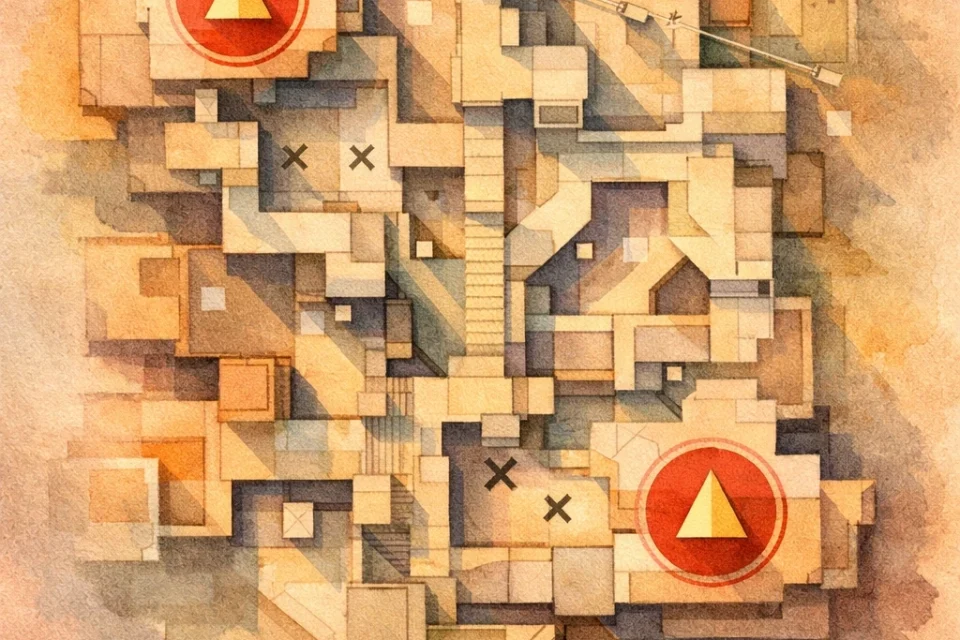
Split at a Glance: Why the Map Plays Differently
Split is a two-site VALORANT map built around A and B, but its identity comes from how tightly it compresses the fight for space. Narrow chokepoints make the first contested area matter, while elevation and vertical traversal add threats that do not always arrive at ground level. The map was designed with an off-site position intended to be important when defending or capturing either site, so rounds often turn on who controls useful territory before the final site fight begins.
That makes Split less forgiving of disconnected play. A team that takes space together, communicates pressure clearly and preserves support for the next fight can make the map feel manageable. A team that enters one at a time often gives defenders the compact engagements they want.
Split Availability and Map Rotation
Split’s availability has changed over time, so it is worth separating a confirmed historical rotation update from a live queue recommendation. In June 2022, an update announced that Split was returning to the Competitive and Unrated map rotation while Bind and Breeze were temporarily removed.
That update does not establish where Split sits in every current mode or rotation. VALORANT’s mode pools can change, and availability may not be identical across Competitive, Unrated and other playlists. Before queuing with a map-specific plan in mind, check the in-game mode information rather than relying on an older rotation announcement.
The practical point is simple: learn Split as a map with a distinct tactical identity, but treat live playlist access as something that can shift. Its two-site structure, tight lanes and vertical pressure remain the useful mental model when it is in your match.
Read the Layout Before You Commit
Start with the broadest reliable read: Split has A and B sites, narrow chokepoints and meaningful elevation changes. Those features create a map where a site hit is rarely just a question of reaching the plant area. Attackers need enough space to move through a tight entry together and enough control to prevent defenders from exploiting height or arriving into the next fight with utility ready.
Mid is commonly part of the broader conversation about space on Split, but the exact links between Mid, the sites and named approach routes should be learned from the current in-game map rather than guessed from a simplified diagram. What matters tactically is the principle behind the design: off-site territory can influence whether either site is secure.
Do not treat a narrow entrance as a signal to rush blindly. Treat it as a decision point. If defenders are prepared, a compressed lane concentrates their firepower and utility. If they have been forced back or distracted, the same lane can become the route that lets your group take ground before the defence can reset.
Use Callouts to Make Fights Easier to Coordinate
On Split, callouts are most valuable when they turn uncertainty into an immediate team decision: where pressure is coming from, where help is needed and which angle remains uncleared. Use the location names shown on the current in-game map and agree on them with your squad. A complete verified catalogue of Split’s named callouts is not included here, so avoid inventing labels mid-round when a clear, shared description will do.
Ropes, Elevation, and Vertical Pressure
Split has vertical ropes leading into both A and B, giving the map a traversal feature that changes how players account for height. The ropes create vertical movement options at each site, so clearing only the obvious ground-level line can leave a team exposed to an opponent using a different elevation.

For attackers, vertical pressure means site control is more than crossing a chokepoint. For defenders, it means a hold can draw value from elevation as well as from the entrance itself. Keep your crosshair and communication flexible: if contact disappears from one level, do not assume the threat has disappeared from the fight.
The exact endpoints, travel directions and movement constraints should be checked in the live map. The durable lesson is to include vertical possibilities in every clear, hold and retake plan.
Attack Split by Creating Space You Can Hold
Split asks attackers to be patient enough to make the eventual site take survivable. Its narrow chokepoints reward defenders who hold them with utility, and elevation can make established setups difficult to dislodge. Instead of treating the first opening as an automatic all-in call, use coordinated pressure to create space that teammates can actually occupy.
That means entering with a follow-up plan. A player who gains ground without support can become isolated; a group that takes ground together can convert the same opening into site control. Retain enough resources and positioning for the round after the spike is planted. On Split, post-plant discipline is often more valuable than forcing a site take before the team is ready to hold it.
Defend the Chokepoints Without Giving Away the Map
Defence benefits from Split’s compact approaches and elevation changes, but a strong hold is not the same as an immovable hold. In a competitive sample of 37,640 Split matches, defenders won 53.0% of rounds and attackers won 47.9%, a 5.2-percentage-point edge for defence. That is a useful snapshot of pressure on the map, not a guarantee for any individual game.
Use utility to make the attacker’s first decision expensive: delay the push, force hesitation or make a tight entry uncomfortable. Then keep enough flexibility to support the other site or respond if attackers claim useful off-site space. Defenders gain the most from Split when they make attackers prove that their entry is coordinated, rather than donating isolated duels at the first sign of contact.
Choose Agents for Entry, Space, and Follow-Up
There is no single role that owns Split. In the same tracked-match sample, Neon recorded a 55.0% win rate, Sage 53.3% and Fade 53.2%. Those results span Duelist, Sentinel and Initiator roles, which is a reminder that team function matters more than forcing a one-role composition. The figures do not explain why those agents performed well on the map, nor do they create a definitive current tier list.
Capability is the more useful lens. Split rewards agents who can help a team take space, support an entry, create a follow-up opportunity or challenge unusual vertical angles. Jett is a clear example on attack: her mobility can let her enter quickly, take space and give teammates a point of momentum to play behind. Updraft can reach unexpected angles on Split, while Blade Storm can be effective in the map’s tight corridors.
Build around the job your team needs done. A mobile entry player is valuable only if teammates can follow. Information, defensive anchoring and pressure that helps convert an opening can matter just as much as the first player through a tight lane.
Split Round Checklist
Before the barrier drops, give the round a shared purpose. On attack, decide whether the priority is applying early pressure, taking useful space before committing, or setting up a site take that leaves enough resources for post-plant play. On defence, decide which early contact you can contest with utility and where a teammate may need quick support. Split’s two sites do not make every round a simple A-or-B choice; control away from the final plant area can still decide whether a site is defensible or capturable.
As contact begins, make communication concrete. Call the location shown on the map where possible, state whether the threat is above or below, and describe what the team needs next: help, a trade, a delay or a regroup. Short calls are especially valuable in Split’s tight lanes because fights develop quickly. “One close” is less useful than a shared location name or a clear description of the level and direction of the threat.
When approaching a site, respect the chokepoint. Do not let one player absorb the entire first fight while the rest of the team is too far away to trade. Use your utility and timing to make defenders react, then move into the space as a group when there is a genuine opening. If the defence has held the entrance comfortably, reassess rather than feeding the same angle. Compact geometry rewards the side that recognises when a plan has stopped working.
Keep vertical pressure in the picture throughout the round. Both sites have ropes that create alternate elevation, so a clean-looking ground-level path is not necessarily a cleared site. Attackers should account for vertical threats while taking control; defenders should remember that attackers can use vertical movement to alter the shape of a fight. The important habit is not memorising a rigid rope play, but asking which level is currently unaccounted for.
After planting, shift from entry speed to hold quality. Take positions that let teammates support one another, keep communication focused on the remaining threats and avoid turning a planted spike into a series of isolated peeks. Split’s defensive lean in the supplied match sample gives attackers another reason to value a controlled post-plant over a rushed attempt to win every duel on entry.
Finally, choose agents and utility with the round’s next decision in mind. Mobility can create the first opening, as Jett’s ability to enter quickly and reach unexpected angles illustrates, but that opening matters only when the team can occupy and protect the space behind it. On Split, the most reliable rounds are usually the ones where entry, support, vertical awareness and post-plant discipline all point in the same direction.